Traditional coastal salt production - unique ecosystems
In various parts of the world, salt is still harvested through traditional, non-industrialized salt pans. Traditional salt pans (often called salinas) are man-made systems of shallow wooden or stone basins where sea salt is harvested using ancient, low-impact methods driven entirely by the sun, wind, and human labor. For thousands of years, these sites provided salt, a crucial resource for food preservation and global trade. These sustainably managed landscapes do far more than just yield a natural resource; they provide an essential habitat for numerous plant and animal species that have co-evolved alongside this historic human activity.
Within these hypersaline ecosystems, one can find rare flora and fauna specifically adapted to environments with high or extreme salinity.
Beyond supporting rare biodiversity, artisanal salt pans serve as crucial ecological refugees. Because they are actively managed by humans, these systems can maintain stable, predictable water levels. This stability acts as a critical buffer against the destruction of natural coastal wetlands caused by sea-level rise and industrial development.


The traditional production of salt relies on unchanged methods, utilizing the exact same tools as hundreds of years ago. This absence of industrialization ensures that both the process and the final products remain entirely natural. In the past, people depended deeply on environmental factors such as the wind, sun, rain, and tides. Because they had to work in harmony with these elements, they developed ingenious methods based entirely on natural solutions.

There are, in principle, two types of salt pan pools: crystallization and evaporation pools. In the evaporation pools, water evaporates, going through many stages of evaporation (increasing from around 3% salinity to 24% salinity). When the water is very dense and the concentration is very high, it enters the crystallization pools. There, as the remaining water evaporates, crystallization occurs and salt emerges. All this depends on the weather – with more sun and wind, this process is shorter, whereas with heavy precipitation, it takes much longer.


In several traditional Mediterranean salt pans, a specialized biological mechanism has evolved.
This mechanism relies on a unique type of biofilm that prevents the salt crystallizing from the water from mixing with the mud at the bottom of the pools. Pioneered on the island of Pag in Croatia, this method depends on a carefully cultivated microbial mat known as petola. This rug-like layer, composed of algae, cyanobacteria, and other microorganisms, blankets the bottom of the crystallization pools. By acting as a natural barrier, the petola prevents the underlying mud from contaminating the evaporating saltwater. Despite being only a few millimeters thick, this dense biological crust is remarkably durable and easily supports the weight of salt workers and their tools.
Because the salt never touches the muddy floor, it remains pure and brilliantly white, skipping the heavy industrial washing that would otherwise strip away its valuable natural trace minerals. Consequently, the harvested salt remains pristine, clear, and mineral-rich, completely eliminating the need for modern industrial washing or post-production processing. This lack of artificial processing makes the final product highly valuable.
Over time, this "natural carpet" has integrated into the local ecosystem, evolving dynamically alongside other coastal organisms.


There are many species that over the centuries evolved together with this substrate. One such is the brine shrimp (Artemia salina). As the petola continuously sheds cells, microalgae, and organic detritus into the water column, brine shrimp swim upside down, using their leaf-like legs to filter these microscopic particles directly out of the brine. They eat the floating fragments of the petola, grow into massive populations and become the primary food source for birds, some also rare, such as in some places the rare black-winged stilt (Himantopus himantopus).


Black-winged stilts, in the search for food.
There are also brine fly larvaes, benthic grazers, specialized to live in salt environments, equipped with specialized mouth hooks. They crawl directly across the surface of the petola mat, literally scraping up and consuming the dense layers of cyanobacteria and diatoms. Many bird species in the salinas feed with brine flies.
The embarkment separating the traditional salt fields provide a unique sanctuary for the salina bee. Instead of occupying wooden hives, these industrious insects burrow directly into the salty mud and ground to craft their nests. Unlike honey bees that live in massive, shared colonies, salina bees are strictly solitary. Yet, while every female excavates her own independent nest, they frequently form dense, bustling settlements featuring hundreds of individual burrows tightly clustered along the salt pans' pathways.
Water canals between the pools, in which brine shrimps can be spotted.


There are also special types of plants, living in these kind of salty environments, called halophytes. They are known to tolerate high of salinity. are specialized, salt-tolerant plants that thrive in environments where most other vegetation would perish, such as salt marshes, mangrove swamps, and coastal deserts. To survive high salinity levels, these remarkable plants have evolved unique physiological adaptations, including salt-excreting glands, ultra-filtration root systems, and succulent leaves that store water to dilute internal salt concentrations.
In Europe, many halophytic plant communities are listed under Annex I of the EU Habitats Directive, making them core components of the protected Natura 2000 ecological network.
There is also a special fish, living in these environments such as the Mediterranean killifish (Aphanius fasciatus).
This small (3–5 cm) banded fish that thrives in coastal lagoons, marshes, and traditional saltpans. This resilient species survives extreme temperatures and hypersaline conditions. It lives by foraging for invertebrates in the shallow waters. It is considered of Least Concern globally by the IUCN, but localized populations are heavily threatened by habitat loss, the destruction of coastal wetlands, and the introduction of non-native species. Because they act as bioindicators for the health of transitional waters, their habitats are strictly monitored.
The Mediterranean killifish is often found in higher numebr in water channels between the pools.
Even though they are primarily found in the evaporation poolsm they are found in high numbers in the channels betwwen the pools.
The intricate network of stone-lined or muddy channels that moves water throughout the salt pans is highly favourable hotspot for these fish.
The channels offer deeper water columns than the flat pools, giving the killifish Better temperature stability during hot summer days, strategic shelter among halophytic vegetation growing along the banks and better hiding spots from predatory wading birds.
They love to graze on the microscopic organisms, detritus, and small larvae that settle on top of the muddy bottoms and the biological petola mats.


Halophytes develop thick, fleshy leaves primarily to store fresh water and dilute the toxic salt concentrations absorbed from their environment. Because these plants grow in highly saline soils—like salt marshes and coastal regions—they experience physiological drought, making it difficult to extract water from the ground. By expanding special internal cells to hold water, thick-leaved halophytes significantly reduce their surface-area-to-volume ratio, which minimizes water loss through evaporation.
One such is Salicornia plant, commonly known as glasswort, sea asparagus, pickleweed, or marsh samphire, a genus of annual, succulent halophytes.
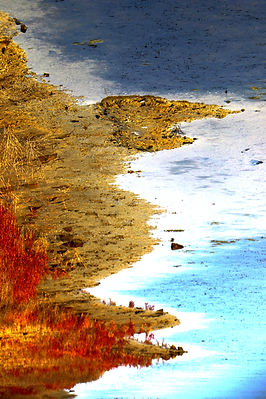
In the late summer and autumn, it turns to orange and purple, turning whole pools into colored fields. It is known for its extreme salt tolerance, with some species thriving in environments with salt levels that would immediately kill ordinary crops.
"Salicornia is also known for its high culinary value. In the past, it was harvested by salt pan workers during the summer months—before the plants began to flower—and eaten for lunch as a salad or a side dish. Today, the plant is protected and cannot be harvested from the wild. However, it is widely cultivated in many countries and sold commercially."

Teals above the fields with Salicornia sp.
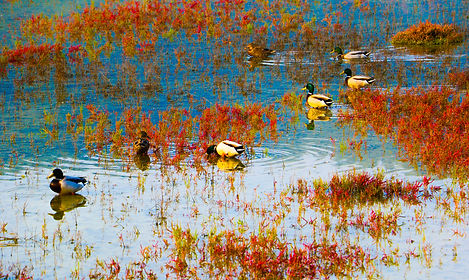
Mallards between in the pools among flowering Salicornia sp.

Salt pan pools with flowering Salicornia sp.

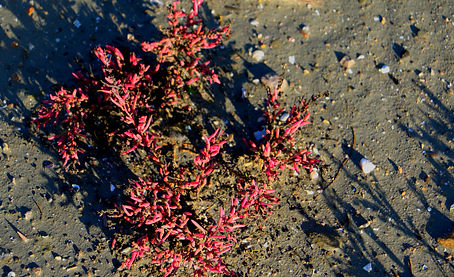
Another flower like that is the Sea aster (Aster tripolium), a resilient halophytic perennial belonging to the daisy family (Asteraceae). It thrives in coastal environments across Europe, North Africa, and temperate parts of Asia, particularly in salt marshes, estuaries, and mudflats where most other plants cannot survive.


The sea aster (Aster tripolium) on the embankments of the saltpans.


Stinkwort (Dittrichia graveolens)
Consequently, these fragile habitats and unique species must be regularly monitored and carefully managed to ensure the long-term preservation of these protected areas.