Marine coastal areas - important bird habitats

Lagoons present important coastal habitats for many organims, one of them deifferent species of birds. They are dynamic, highly productive wetlands that support massive, diverse bird communities. They act as critical feeding and resting habitats for waterbirds, wading birds, and migratory species along global flyways. Because of their shallow, sheltered waters, they boast an abundance of fish, crustaceans, and aquatic insects. Many waterbirds (such as herons, egrets, and waders) rely on shallow waters (typically 0–20 cm) to wade in and hunt for small fish, crustaceans, and insects.
In lagoonish enivronments there ere are many small organisms such as invertebrates, fish and plants that thrive de to their shallowness. When birds migrate, especially during spring and autum, this presents an important stop for their routes, since they loose a lot of energy on their flights and need places to rest and regain their energy. Millions of migratory birds use them to refuel on their long journeys between breeding and non-breeding grounds.

These buffer zones are uniquely vulnerable to climate change. Rising sea levels, warming waters, and altered precipitation patterns directly threaten their complex hydrology, biodiversity. As the global mean sea level rises, coastal lagoons face the threat of becoming completely submerged or converted into open marine bays.
Wetlands are disappearing three times faster than forests, with nearly 35% of the world's wetlands lost since 1970. These are driven by agricultural expansion, urbanization, and climate change. This loss destroys vital carbon sinks and natural flood buffers, putting trillions of dollars in global ecological benefits at risk.
With rising sea levels, coastal lagoons face the threat of becoming completely submerged or converted into open marine bays. Global mean sea level (GMSL) has risen by about 21–24 centimeters since 1880.
Birds remeber different landmarks. They use distinct geographic features, like rivers, mountains, coastlines, and even buildings to build "mental maps" of their territories and migratory routes. Studies on species like pigeons and hummingbirds show they rely on prominent visual cues to return to exact feeding grounds, nests, and home bases. Some studies suggest this happens already when seeing places for a single time. For long-distance migration, landmarks often act also as secondary guidance.
One of such species, is the great egret (Ardea alba), that can be found in wetlands all over the world. They are massive bird, standing up to 1 meter tall. They have entirely snow-white plumage, a very long, dagger-like yellow bill, and completely black legs and feet. They are incredibly efficient fliers, cruising at over 40 km/h while flapping their wings only two times per second.
They inhabit both inland and coastal wetlands, strictly preferring areas with shallow water and minimal aquatic vegetation so they can spot their prey easily. They easily adapt to human-made water structures, frequently hunting in fields and agricultural areas. They are highly skilled, patient predators that rely on stealth and precision. Unlike smaller birds that chase their prey, great egrets use a "sit-and-wait" approach, combined with lethal speed.


Great egrets (Ardea alba)
The little egret (Egretta garzetta) is a small, snow-white heron known for its elegant proportions, striking contrast of colors, and dynamic hunting style. During the late 19th and early 20th centuries, they were nearly wiped out in Europe due to the global fashion trade.
During the spring breeding season, adults grow long, delicate, lace-like plumes on their crest and back.
While they look incredibly graceful and silent when foraging, little egrets are actually quite loud and harsh when they are around other birds. They are frequently seen following large grazing animals, like cattle, horses, or even wild water buffalo, through wet fields. As these heavy animals walk, they disturb grasshoppers, frogs, and beetles from the grass. The egret stays right at their heels, snapping up the fleeing prey.
They can be distinguished from great herons by their smaller body size and black beaks.


Little egrets (Egretta garzetta)
The grey heron (Ardea cinerea) is a large, majestic wading bird native to temperate regions of Europe, Asia, and parts of Africa. It is highly adaptable, found in coastal salt marshes and estuaries to inland rivers, lakes, and urban parks. It is around 1 meter tall with an impressive wingspan up to 175 centimeters. Despite its large size, it is incredibly light, weighing only between 1 and 2 kilograms due to its hollow bones. They can be easily distinguished apart from a stork or crane because they retract their necks into a tight 'S' shapes.
While they hunt alone, they are highly social when it comes to breeding. They nest in colonies, typically built high up in the canopy of mature trees near water bodies.


Grey heron (Ardea cinerea)
Great cormorants (Phalacrocorax carbo) are frequently found in coastal wetlands like saltmarshes, as well as estuaries, tidal mudflats, and salt pans.
They are found across much of the world, including Europe, Asia, Africa, and North America.
They are highly adaptable waterbirds, and thrive in almost any aquatic environment that provide an abundant supply of fish. They are apex underwater hunters, they can dive up to 9 meters deep and hold their breath for over a minute to chase fish. Their eyes are specially adapted to see perfectly both in the air and under water. Because they are highly efficient fishers, they often find themselves in conflict with commercial fishing and angling communities. In parts of China and Japan, traditional fishers have used trained Cormorants for thousand of years. The fishers tie a loose ring around the bird's throat so they cannot swallowthe fish, allowing the fisher to retrieve them.


Great cormorants (Phalacrocorax carbo)
The Pygmy Cormorant (Microcarbo pygmeus) is the smallest member of the cormorant family in Europe, measuring nearly half the size of the Great Cormorant. They have a relatively short beak and a long tail. Unlike their relatives, they heavily prefer freshwater environments, thriving in vegetated areas like silted river deltas, shallow lakes, reed beds, and flooded fields.
They are exceptional swimmers and divers, primarily hunting small fish and amphibians in shallow waters. During the breeding season, adults are dark brown and black with tiny, white feather tufts scattered across their heads and necks. In the winter, their plumage dulls, and their throat turns a pale whitish.
They breed primarily in southeastern Europe and southwest Asia. They are highly social and build nests out of sticks and reeds up in trees or in dense bushes. They love company and almost always nest in tight-knit colonies alongside other wetland birds like herons, egrets and ibises.


The Pygmy Cormorant (Microcarbo pygmeus) in the company of some other coastal species
Mallards (Anas platyrhynchos) are the most common wild ducks in the world. Males have a bright green head, a white neck ring, a yellow bill, and a brown chest. They are the direct ancestor of almost all domestic duck breeds. They are wildly successful because they are incredibly adaptable - they can thrive in almost any wetland habitat.
Males are easily recognizable by the glossy, iridescent bottle-green heads, while females wears brown camouflage pattern to stay hidden while nesting. Both males and females share a striking, metallic blue-purple wing patch bordered by white lines, highly visible when flying.
They are highly migratory in the northern parts of their range, but they are partial migrants, meaning that while northern populations fly south for the winter, mallards living in milder, temperate regions often stay in the same place year-round.


Mallards (Anas platyrhynchos)
The Common Shelduck (Tadorna tadorna) is the most widespread and recognizable shelduck species. This large, striking bird is essentially the signature waterfowl of European and Asian coastlines.
It is incredibly easy to identify because it wears a bold, high-contrast pattern, They have a stark white body, a dark, glossy bottle-green head, with the most defining feature a vibrant, bright red bill. They are famous for nesting in underground holes, including holes in cliffs above the sea. After breeding, they drop all of their flight feathers at once, leaving them completely flightless and vulnerable for about a month.
The Common Shelduck's entire life revolves around tidal mudflats because of their favorite food, the tiny mud-snail. They can consume thousands of these tiny snails every single day, using a highly specialized beak adapted for this purpose.


The Common Shelduck (Tadorna tadorna)
The Eurasian teal (Anas crecca) is the smallest dabbling duck in Europe, measuring 34-38 cm in length. This migratory species is a frequent winter visitor to Mediterranean wetlands, coastal lagoons, and traditional salt pans. Because of their tiny size, teals rely heavily on the shallowest pools of salt pans. They prefer water depths of just a few centimeters to filter micro-invertebrates.
Teals are highly migratory and use Mediterranean salt pans as vital "gas stations" to rest and refuel during the winter. Some populations breed as far away as Siberia and Scandinavia before flying southwest to winter in Spain, Italy, and North Africa. Both females and males, display a brilliant, iridescent emerald-green wing patch that is highly visible during flight.
Mallard (Anas platyrhynchos)


The Eurasian teal (Anas crecca)
The Black-headed Gull (Chroicocephalus ridibundus), a small, widespread bird found across Europe and Asia, is a regular guest in such coastal areas.
The head is not actually black. In summer, it has a chocolate-brown hood. In winter, the head turns white with a dark spot behind each eye. Their scientific name, Chroicocephalus ridibundus, means "laughing," because their calls sound like laughter. They live a relatively long time, the oldest recorded wild individual lived for nearly 33 years.
They can be easily mistaken for the Mediterranean gulls (below). The can be distinguished by some details, such as the shape of their beak, the coloration of feathers on their back, on the head and the coloration of their legs.


The Black-headed Gull (Chroicocephalus ridibundus)
The Mediterranean Gull (Ichthyaetus melanocephalus), a similar species of gull, is a regular visitor of such areas. Outside of the breeding season, they love to frequent salt marshes, sandy beaches, lagoons, and agricultural fields.
They regularly breed in scattered colonies across western, central, and northern Europe. They frequently nest inland on islands within large steppe lakes, shallow reservoirs, or dense marshes. Rather than the harsh cackling or laughing sounds of other species, they give They are opportunistic omnivores, while they do forage along the coastlines for fish and mollusks, they spend an enormous amount of time inland. They regularly follow tractors on farmlands to feast on earthworms, beetles, grasshoppers, and even mice.
When they molt into their winter plumage, the black hood completely disappears and iis replaced by a dark, smudge-like pattern.
Despite its common name, the Mediterranean Gull is actually quite scarce around parts of the Mediterranean coast.

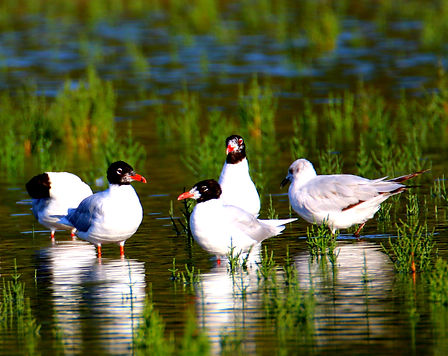
The Mediterranean Gull (Ichthyaetus melanocephalus)
The little grebe (Tachybaptus ruficollis), also known as the dabchick, is one of the smallest and most widespread members of the grebe family. It is found across Europe, Asia, and parts of Africa. Unlike ducks, grebes are specialized diving birds. They have lobed toes, with legs set far back on their bodies. While this makes them clumsy on land, it makes them powerful swimmers. They are opportunistic carnivores.
They dive to catch small fish, aquatic insects, larvae, snails, crustaceans, and tadpoles. Their chicks can swim shortly after hatching, but they frequently ride on their parents' backs, tucked inside their feathers, while the parents swim and dive for food. They have floating nests - they build floating platforms of rotting aquatic vegetation, anchored to reeds or submerged branches.

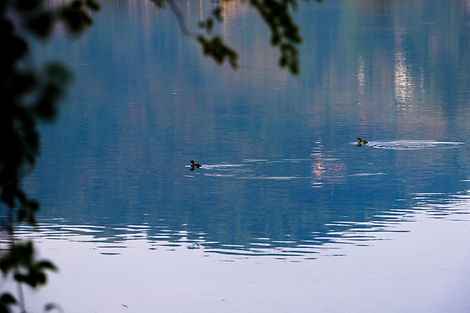
The little grebe (Tachybaptus ruficollis)