Amphibians in Europe
There are over 80 species of amphibians in Europe, including frogs, toads, newts, and salamanders. Many of them are not found nowhere else in the world.
Because of their permeable skin, they are highly sensitive bioindicators of wetland and freshwater ecosystem health. Today, many species face severe population declines due to habitat loss and disease.
According to the IUCN Red List, amphibians are among the most threatened vertebrate classes. Nearly a quarter of European species are considered threatened.
Almost all species require high moisture to stay alive, their skin is highly permeable, meaning they can dry out quickly and suffocate without humidity. Most species also need water bodies to reproduce, they return to ponds, lakes, or slow streams to lay eggs.
Because wetlands are one of the fastest declining habiats these days, this affects also amphibian species, tied to such environements. Today, nearly 41 % of all evaluated amphibian species are threatened with extinction.
European tree frog (Hyla arborea)
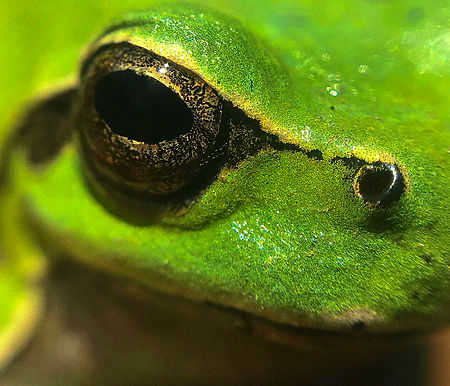
The European tree frog (Hyla arborea) is a small, iconic amphibian renowned for its brilliant green color and exceptional climbing skills. It belongs to the family Hylidae and is the only native representative of the tree frog family widespread across mainland Europe.
They are small and delicate, measuring 3 to 5 centimeters in length. Their fingers and toes terminate in specialized sticky adhesive discs, which allows them to scale vertical surfaces, including trees and reeds. While normally a smooth, luminous leaf-green, they can alter their color to gray, brown, or yellow depending on the temperature, humidity, or their mood. Despite their tiny body weight of only 4 to 10 grams, the males feature large vocal sacs. Their intense, rhythmic mating calls can be heard over a kilometer away.
The Common Toad (Bufo bufo) is one of Europe's largest and most widespread amphibians, familiar for its stocky build and dry, bumpy, warty skin. They are generally brown, olive-brown, or grey, with females typically being larger (up to 10 cm to 13 cm) and browner than the slightly smaller, greyer males.

Baby common toad (Bufo bufo)

When threatened, they puff up their bodies and lower their heads to look bigger. They also secrete a toxic, foul-tasting substance.
Unlike typical frogs that rely on near-water habitats and jump, toads are heavily adapted for land and move by walking or shuffling forward.
They are nighttime predators, using their long, sticky tongues to hunt a wide range of invertebrates.
Toads are fiercely loyal to their ancestral breeding ponds—the exact water bodies where they hatched as tadpoles. They will walk up to several kilometers to reach them, completely oblivious to any human roads built across their historical paths.
When spring temperatures rise above 5°C to 7°C and the night is wet or rainy, thousands of toads emerge from the forest floor at the exact same time. Toads navigate using a mix of the Earth's magnetic fields, the smell of specific algae in their home pond, and auditory cues (hearing other male toads calling). Unlike frogs that leap quickly, toads crawl or hop very slowly. A single road crossing can take a toad several minutes, maximizing their exposure to traffic. Roads absorb heat during the day. Migrating toads often stop there at night just to warm up their cold bodies, significantly increasing their chances of being crushed.
That is why roads are a severe, catastrophic threat and considered one of the leading causes of local toad population collapses across Europe.
Juvenile common toad (Bufo bufo)

Holarctic true frogs (genus Rana) are a group of roughly 50 to 54 recognized species of classic, semi-aquatic amphibians. Widely referred to as "pond frogs" or "brown frogs," they are primarily distributed across the temperate and subtropical regions of North America and Eurasia.
They typically possess slim waists, smooth or slightly wrinkled skin. They are equipped with long, muscular hind limbs designed for powerful jumping on land and extensively webbed feet for swift swimming.
They generally favor cryptic greens, browns, and grays with darker spots to blend seamlessly into leaf litter and pond margins.
They are opportunistic predators, using a sticky tongue to capture insects, spiders, and small invertebrates.
Males gather in wetlands during spring to engage in vocal chorus competitions to attract mates. Later on, females lay large, jelly-like clumps of eggs directly in the water, which develop into aquatic tadpoles before transforming into terrestrial or semi-aquatic adult frogs.
Holarctic true frog (Rana sp.)
Newts are a specific group of salamanders that belong to the subfamily Pleurodelinae, distinguished by their unique three-stage life cycle and rough skin compared to other amphibians. While they share the same coastal or damp landscapes as some of the organisms we discussed, they live a highly unique life splitting time between land and water.
Unlike most amphibians that change directly from a tadpole into an adult, many newts go through an extra, unique middle stage:
Aquatic Larva: They hatch from eggs laid in freshwater ponds or slow-moving streams. They have feathery external gills to breathe underwater and a fin-like tail for swimming..
Terrestrial "Eft" Stage: After a few months, they lose their gills, develop lungs, grow legs, and crawl out onto land. In this youth stage, called an eft, they often turn bright colors (like orange or red) to warn predators that they are toxic. They can live on land for up to 7 years.
Aquatic Adult: When they reach maturity, they return to the water to breed. Their skin changes back to a smoother texture, and males often grow large, colorful fins or crests along their backs to attract mates.

Smooth newt (Lissotriton vulgaris)