The invasion of blue crabs
The blue crab (Callinectes sapidus), is a native species in the Atlantic region, occuring in the east coast of North and south America. In the last decades, the species is spreading from its native range extremely rapidly and has due to its potential significant impacts on the newly arrived ecosystems. It was found to be among the 100 most invasive species on the planet.
Due to ist rapid growth and fast reproduction, it is known to be invasive in certain areas of the world. In the Mediterraean region, it was first observed in the coast of France around 1900, probably as a conserquence of the discharge of the balast waters from transoceanic ships. In the following decades, around 1930-1940, the species spread around the region also to the Eastern Mediterranean. In the cosequent years, many sightings in the region were reported about the new occurrence of this species.
The Atlantic blue crab is classified as a highly destructive invasive species due to the severe damage it inflicts on both local ecosystems and regional economies.The blue crab causes severe damage to local small-scale fisheries by reducing catch volumes and injuring target species through predation. Furthermore, their sharp claws frequently damage fishing gear, shortening its lifespan and inflicting direct financial losses. This invasive species also drives declines in various marine populations, including several threatened taxa, and its intense competition has led to the near-total disappearance of certain native species from invaded ecosystems.

In their native American habitats, blue crabs enter a state of dormancy (hibernation) when water temperatures drop below 12°C. This winter sleep naturally regulates their numbers because freezing cold spells lead to high winter mortality. Because of global warming, winters in the Mediterranean and Northern Adriatic are becoming increasingly mild. The crabs no longer hibernate. Instead, they stay active, eat constantly, and reproduce almost year-round. Without winter cold to naturally cull their population, their numbers have exploded exponentially. Also, higher water temperatures speed up the biological processes of marine life. In warmer waters, blue crabs reach maturity faster and can spawn multiple times per season.
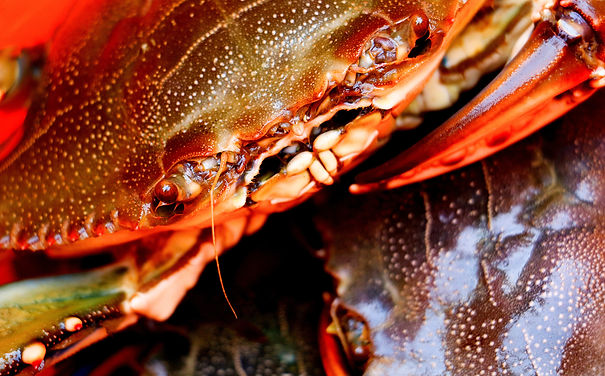
The body is covered by a wide, flattened shell (carapace) that is broader than it is long. A sharp, prominent spine projects outwards from each side of the carapace, acting as a defense mechanism against predators. Males generally grow larger and wider, developing heavier and thicker claws. Claw tip color offers an immediate visual distinction; males have bright blue highlights across their entire claws, while females have bright red or orange tips on their pincers. Females mate only once during their terminal molt, holding a massive egg mass. A single mature female blue crab can produce between 2 million to 8 million eggs in just one spawning event. Over her entire lifetime, she can lay as many as 7 to 18 successive egg masses from sperm she retains from a single mating.
Its scientific name translates to "beautiful savory swimmer," which perfectly captures its appearance and mobility.
They are opportunistic omnivores that eat almost anything they can catch. Their diet includes clams, oysters, mussels, smaller crustaceans (including other blue crabs), worms, and small fish. They also act as scavengers, feeding on dead animals, as well as plant matter and organic detritus. When they reproduce in large numbers, their predation can have severe effects on the native ecosystems.

The financial and ecological damage caused by the Atlantic blue crab invasion in Italy and Southern Europe is staggering. Industry experts and agricultural groups estimate that the total economic damage to Italy’s fishing and aquaculture sectors has reached roughly €200 million.
In Italy, they have been documented causing massive damage to shellfish farms. Blue crabs do not just target adult clams; they selectively hunt juvenile clams (seed clams). By crushing the fragile shells of baby clams before they can grow, the crabs completely disrupted the future biological cycle of the farms. In the worst-hit areas of the Po Delta, clam harvests plummeted by a staggering 90%. For instance, the annual turnover of the Italian clam sector crashed from a peak of €120 million down to just €13 million. Between 2024 and 2026, authorities paid local fishermen to catch and incinerate nearly 2.3 million kilograms of blue crabs to thin their numbers.

Traditional fishing nets are easily torn apart by the blue crab's sharp claws. To fight back, fishers use reinforced wire-mesh pots specifically modified for this invasion. They are heavy, square boxes made of steel wire. The traps feature funnel-shaped entries or "throats." The crabs easily crawl inside to reach the bait (usually fish or meat) but can not squeeze back out. According to recent aquaculture studies, scientists have been testing very specific modifications to these traps to make them even more efficient against this species. For example, recent field trials proved that using bright yellow plastic entry funnels instead of traditional dark green ones increases catch rates by over 30%, as this color highly attracts them.
Trap for removing blue crabs.


Caught blue crabs from one of the traps.


Taking measurements of the caught individuals.
When the Atlantic blue crab invades a new environment, it acts less like a standard marine creature and more like an 'ecological bulldozer.' Because it is highly adaptable, aggressive, and lacks widespread natural predators in Europe, it completely reshapes the local food web from the bottom up. It consumes an enormous volume of bivalves, including clams, mussels, and oysters; by systematically wiping out these species—reducing clam biomass by up to 71% in heavily invaded lagoons—the crab removes the ecosystem's natural water filters. The native Mediterranean green crab (Carcinus aestuarii) shares the exact same habitat and food sources. Because the Atlantic blue crab is larger, stronger, and more aggressive, it easily outcompetes the native crab. In places like Sicily and the Po Delta, the native green crab has virtually vanished, tearing a crucial link out of the local food chain.

In August 2026, marine biologists launched a project, releasing roughly 150,000 baby octopuses into the Adriatic Sea near coastal towns like Riccione and Cesenatico. The goal is to use octopuses as natural predators, as a single mature octopus can eat up to four blue crabs a day. The common octopus was chosen specifically because it is incredibly hardy, reproduces rapidly, and naturally possesses a voracious appetite for hard-shelled crustaceans. Researchers captured and bred common octopuses in large white water tanks and then released them into the sea. To give the released octopuses a fighting chance, marine biologists deployed artificial concrete and clay reefs across the seabed to act as underwater dens, allowing the growing octopuses to establish a home base close to the blue crab populations. However, the University of Bologna team emphasized that the octopus release is not a stand-alone solution, but rather a supplementary ecological tool.

Despite these innovative ecological initiatives and massive culling efforts, the blue crab invasion remains a critical, unresolved crisis. Because climate change continues to warm the seas, the long-term impact of this biological disruption is still highly unpredictable. Scientists and fishermen simply do not know if native predators like the octopus will be enough to restore balance, or if the blue crab will permanently reshape the marine ecosystem and coastal economies for decades to come. As waiting to see the results of biological experiments like the octopus release, one thing is certain; the crisis forces to rethink how to protect marine life, before global warming alters the coastal waters beyond recognition.
