Hidden underwater treasures
Sea meadows
Seagrass meadows are among the world's most vital yet vulnerable ecosystems, and they are currently disappearing at a very fast rate.
Despite their name, seagrasses are not seaweed. They are the only underwater flowering plants (angiosperms) that migrated from land back into the ocean around 100 million years ago. They have real roots, leaves, produce flowers, and even release seeds. Because seagrasses live in harsh underwater environments, they produce unique chemical compounds to defend themselves. Scientists are actively studying these molecules for potential use in human medicine.
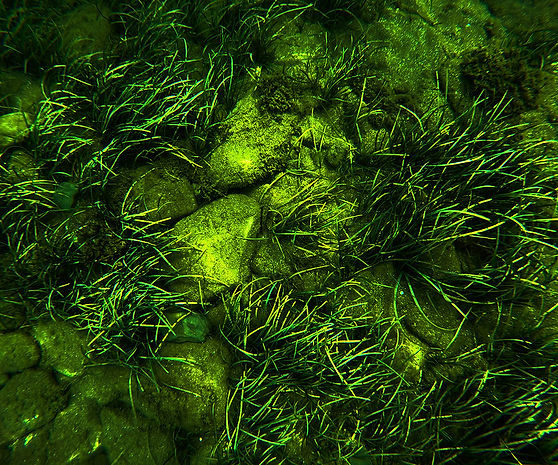
Despite that, they are one of the fastest declining marine habitats. It is evaluated that they aredisappearing globally at an alarming rate of roughly 7% each year.
When seagrasses becomes stressed, they become more vulnerable and prone to overgrazing and diseases.
There are currently around 10 species of seagrasses that are at risk of extinction. However, science shows that when we actively protect and restore these meadows, they possess a remarkable ability to bounce back and heal the surrounding ocean.
_JPG.jpg)

A single acre of seagrass can house over 30 000 fish and a million invertebrates. Their root systems provide vital protection for juvenile fish, crabs, and endangered seahorses.
Large marine herbivores like green sea turtles and dugongs depend almost exclusively on healthy seagrass for food. The collapse of these meadows forces these animals to migrate or starve.

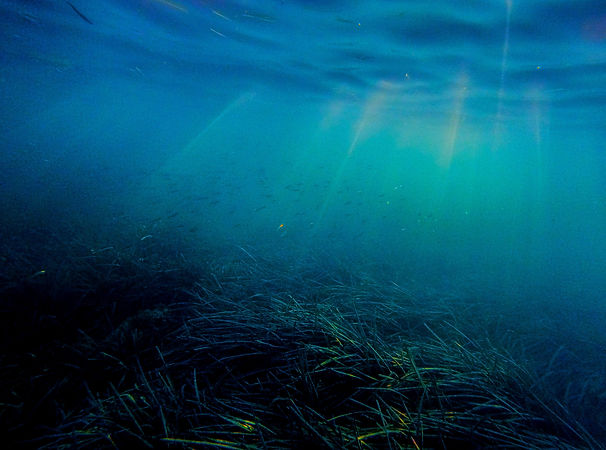
These underwater habitats play a critical role in marine ecology by providing essential breeding, nursing, and foraging grounds for a vast diversity of marine species. By offering complex structural cover, they serve as a sanctuary where marine life can seek shelter from predators and find abundant food sources. Beyond supporting biodiversity, seagrasses act as crucial ecosystem engineers. Through photosynthesis, they oxygenate the water column, sustaining marine life.
Furthermore, they have many other hidden functions. They function as resilient coastal shock absorbers; by slowing down wave energy and dampening strong currents, they stabilize the seabed and mitigate coastal erosion. On a global scale, seagrass meadows are powerful allies against climate change. They excel at carbon sequestration - storing vast amounts of atmospheric carbon dioxide (CO2) in their dense root systems and surrounding sediment, known as "blue carbon." Eventhough they cover less than 0.2% of the ocean floor, they absorb 10% of the ocean's carbon annually, capturing carbon up to 35 times faster than tropical rainforests.
There are several threats to those habitats, among them:
Rising Sea Temperatures - Escalating water temperatures trigger thermal stress and widespread mortality events. This warming trend is currently standing as the primary driver of marine biodiversity loss. Because they are stationary plants rooted to the seafloor, they cannot migrate to cooler waters when marine heatwaves strike. When water temperatures exceed their specific biological tolerance limits, entire meadows can collapse rapidly. Warmer water also holds significantly less dissolved oxygen and at the same time, high temperatures accelerate the decay of organic matter in the sediment, creating an oxygen-depleted (anoxic) environment that suffocates the seagrass root systems. In warm, oxygen-poor sediments, specialized bacteria thrive and produce high levels of hydrogen sulfide. This toxic gas penetrates the stressed roots, poisoning the plant from the inside out.
Climate Change and Intensified Storms - Climate change fuels more frequent and intensified storms that physically rip up seagrass meadows, erode sediment, and cut off essential sunlight. They can bury them under shifted sediments and cut of the needed light conditions. Storms also wash heavy loads of soil, debris, and pollutants from the land into coastal waters. This runoff triggers intense turbidity (cloudiness) that blocks sunlight for weeks, starving the seagrass of the light needed for photosynthesis. Slow-growing species like the Mediterranean's Posidonia oceanica can take decades or even centuries to naturally recolonize a seafloor area that a single major storm destroyed in a few hours. Extreme storms break continuous underwater meadows into small, isolated patches. These fragmented habitats are much less resilient to secondary threats.
Coastal Development - Construction activities like dredging, building ports, constructing marinas, creating artificial beaches, and laying underwater cables stir up massive clouds of mud and sand and resuspend seabed sediments, directly damaging the meadows. Furthermore, these coastal works introduce fine particulate matter into the water column, escalating turbidity and drastically reducing the light penetration essential for photosynthesis and growth. Deep seafloor sediments often lock away heavy metals, pollutants, and excess nutrients accumulated over decades. Construction reshuffles these layers, releasing toxins that poison the plants and nutrients that trigger light-blocking algal blooms. Construction often permanently changes the composition of the seafloor (e.g., turning a firm seabed into thick, unstable mud). This prevents the roots from re-establishing even long after construction ends. The muddy water forces adult fish to flee, while the juvenile fish and invertebrates hiding in the grass canopy are trapped and directly suffocated by the settling silt. Sharp sand particles stirred up by heavy machinery and currents act like sandpaper; this abrasive cloud physically scores, tears, and damages the delicate blades of the seagrass.
Sea Level Rise - Because seagrasses are flowering plants, they have exceptionally high light requirements compared to other marine life. As sea levels rise, the water column above them deepens, filtering out the vital light they need for photosynthesis.
Agricultural Runoff - This is known as one of the leading drivers of worldwide seagrass decline, triggering a destructive process called eutrophication. When farmers apply chemical fertilizers and animal manure to inland field, rain flushes the excess nutrients, specifically nitrogen and phosphorus, into the rivers, which eventually empty into coastal bays and estuaries where seagrasses grow. This acts as a super-fertilizer for microscopic algae (phytoplankton) and macroalgae, which multiply exponentially and block the solar radiation from penetrating the water column. Additionally, chemical herbicides directly disrupt their growth and reproductive cycles of the seagrasses.
Unregulated Fishing and Anchoring - Commercial fishing boats using bottom trawls drag heavy, weighted nets directly across the ocean floor. This completely plows the seagrass meadows, uprooting the plants and destroying entire habitats in a single pass. When speaking of anchoring, when a boat drops a traditional heavy iron anchor into a seagrass bed, the anchor digs into the sediment and rips out the roots (rhizomes). Also, as wind or current moves the anchored boat, the heavy chain drags along the seafloor. This chain acts like a lawnmower, completely shaving away the seagrass canopy and leaving a stark, circular clearance known as an "anchor scar". Once an anchor scar breaks open, the normal ocean currents begin to erode the exposed sand edges. What started as a small anchor hole can widen over time into a massive, barren blowout.


_edited_edited.jpg)
Why is their dissapearing so bad?
When seagrass dies, the ancient sediment beds holding "blue carbon" erode, potentially releasing centuries of stored greenhouse gases back into the water and atmosphere. Seagrass roots literally trap and stabilize sand on the ocean floor. Without them, storm waves hit beaches with full force, accelerating coastal destruction.
_edited_edited.jpg)
Therefore, protecting these underwater prairies is not just an environmental issue, but a vital investment in global climate stability, food security, and the long-term survival of coastal economies worldwide.

References
- Cullen-Unsworth L. and Unsworth R. 2013. Seagrass Meadows, Ecosystem Services, and Sustainability. Environment: Science and Policy for Sustainable Development 55(3): 14-28.
- Capistrant-Fossa, K. A., Dunton, K. H. 2004. Rapid sea level rise causes loss of seagrass meadows. Commun Earth Environ 5, 87.
- Duarte C. M. 2017. Reviews and syntheses: Hidden forests, the role of vegetated coastal habitats in the ocean carbon budget. Biogeosciences 14:301–310.
- Marieke M. van Katwijk, Brigitta I. van Tussenbroek, Steef V. Hanssen, A. Jan Hendriks, Lucien Hanssen. 2021. Rewilding the Sea with Domesticated Seagrass, BioScience, Volume 71, Issue 11, November 2021, Pages 1171–1178.
- Waycott M., Duarte C. M., Carruthers T. J., Orth R. J., Dennison W. C., Olyarnik S., Calladine A., Fourqurean J. W., Heck K. L. Jr., Hughes A. R., Kendrick G. A., Kenworthy W. J., Short F. T., Williams S. L. 2009. Accelerating loss of seagrasses across the globe threatens coastal ecosystems. Proc. Natl. Acad. Sci. 106(30): 12377-12381.