The unwanted catch

Bycatch and discarding represent one of the most significant threats to modern marine biodiversity, driving severe ecosystem imbalances and the collapse of vulnerable species. When commercial fishing vessels deploy unselective gear, such as bottom trawlers, longlines, and gillnets - they routinely sweep up massive volumes of non-target marine life alongside their intended species. This accidental harvest includes everything from undersized juvenile fish to endangered marine megafauna, including sharks, sea turtles, seabirds, and cetaceans. Because these animals frequently hold little commercial value, violate strict regulatory quotas, or are legally protected, fishermen throw them back into the ocean, a destructive practice known as discarding.
Tragically, the assumption that these creatures can swim away unharmed is a myth; the crushing weight of the nets, rapid pressure changes during hauling, and prolonged exposure to air cause that the vast majority are returned to the sea dead or dying. Organizations like the World Wildlife Fund (WWF) and NOAA Fisheries warn that this continuous dumping of millions of tons of unutilized biomass severely disrupts local food webs. It artificially increases the organic matter available to scavengers while simultaneously depleting top-tier predators and wiping out future generations of commercial fish populations. Consequently, high bycatch rates serve as a definitive metric for unsustainable fishing practices, proving that modern industrial fleets are extracting marine biomass far faster than fragile ocean ecosystems can regenerate.
Towards the end of the twentieth century, initial scientific assessments conservatively estimated that incidental bycatch accounted for approximately 10% of the total global biomass extracted from marine fisheries. However, as monitoring methodologies advanced and research expanded, a far more alarming reality emerged. Comprehensive data collection revealed that bycatch actually constitutes between 10% and 20% of the global catch, meaning that up to one-fifth of all captured marine life is taken unintentionally and often left unutilized. This creates a severe biological deficit, as many of these organisms fail to survive the immediate trauma of capture or succumb to delayed physiological stress shortly after being released, leading to an immense waste of organic matter.
Importantly, these macro-level statistics represent a broad global average that masks extreme variations among different fishing techniques and gear types. While some selective fisheries maintain lower discard rates, unselective industrial methods present a drastically different scenario. Bottom trawling stands out as one of the most ecologically destructive practices, with benthic nets systematically scraping the ocean floor and sweeping up everything in their path, resulting in catastrophic discard rates that routinely reach or exceed 55%, which means more than half of all marine life caught is being thrown away.
_edited_edited.jpg)
Red comb star (Astropecten aranciacus), caught as bycatch.

Bycatch of vulnerable species is one of the most critical conservation issues in marine biology. While the accidental capture of commercial fish causes economic and organic waste, the bycatch of vulnerable species, such as sharks, sea turtles, marine mammals, and seabirds, can drive entire populations to the brink of extinction.
- Sharks and Rays: Apex predators like sharks are highly susceptible to longlines and gillnets. Many shark species must keep swimming constantly to force water over their gills; when trapped in nets or hooked on lines, they rapidly suffocate.
- Sea Turtles: As air-breathing reptiles, sea turtles must regularly surface for oxygen. When they are swept up by bottom trawlers or entangled in gillnets, they become trapped underwater and tragically drown.
- Marine Mammals: Dolphins, porpoises, and seals frequently collide with nearly invisible gillnets or swim into purse seine nets targeting tuna. The most extreme example is the critically endangered vaquita porpoise in the Gulf of California, pushed to near-extinction primarily by illegal gillnet bycatch.
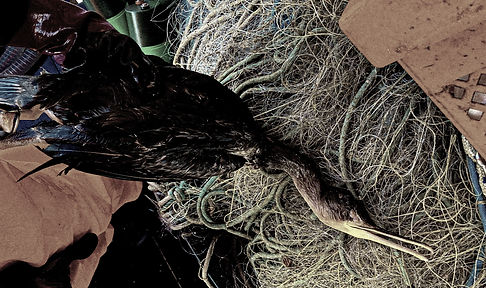
- Seabirds: Foraging seabirds routinely follow industrial longline vessels. As miles of lines with thousands of baited hooks are deployed, birds dive to grab the bait, become hooked, and are dragged underwater where they drown.
Other small organisms, such as invertebrates and plants are usually overlooked in the terms of bycatch.
Marine invertebrate species are usually small animals, but they can have an important role in ecosystems. For instance, sponges and tunicates filtrate large quantities of water and by that remove excessive nutrients. Corals provide habitat for many other marine species.
Plant material such as sea grasses and kelp forests provide habitat for various animals and stabilize coastal areas. There are whole communities on the bottom of the sea. Not many, but a few studies were made regarding bycatch of all organisms, including invertebrates. These studies concluded that when such organisms are included, the incidental catch can be several times higher then previous studies, even up to 60 % of all catch, which means the majority of biomass unintentionally caught is often overlooked.
Long-snouted seahorse (Hippocampus guttulatus)
Some of the species being caught as bycatch:

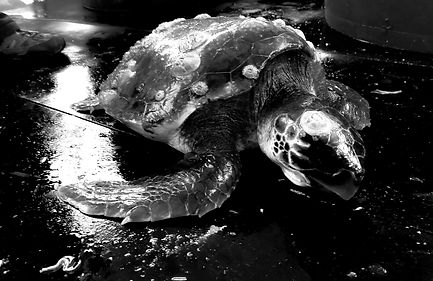
Loggerhead seaturtle (Caretta caretta)
Thornback skate (Raja clavata)

Mediterranean starry skate (Raja asterias)

Greater weever (Trachinus draco)


Angler fish (Lophius piscatorius)
Large-scaled gurnard (Lepidotrigla cavillone)
Greater weever (Trachinus draco)

Stargazer (Uranoscopus scaber)

Common eagle ray (Myliobatis aquila)
Mediterranean shag (Gulosus aristotelis desmarestii)

Pelagic Stingray (Pteroplatytrygon violacea)

Spider crab (Maja sp. )
What are the solutions?
To mitigate the devastating impacts of unselective fishing, modern fisheries management relies heavily on targeted technological modifications. For marine vertebrates, solutions frequently involve behavioral deterrents designed to exploit the sensory systems of non-target species. Visual deterrents, such as green LED lamps attached to gillnets, have proven highly effective at altering the behavior of sea turtles, which possess acute underwater vision; the illumination allows them to perceive and avoid the net without reducing target fish catches. Similarly, acoustic deterrents, commonly known as "pingers," emit localized underwater sounds that alert the echolocation systems of marine mammals, successfully steering dolphins and porpoises away from fatal entanglements.
When speaking of invertebrates, possible solutions are attaching nets of bigger mesh sizes to the bottom of nets so there is less chance of organisms being entageled and brought to the vessels.

Long-armed elbow crab (Derilambrus angulifrons)


Star Tunicate (Botryllus schlosseri)
Shell of a gastropod

Stalkeye porter crab (Ethusa mascarone)
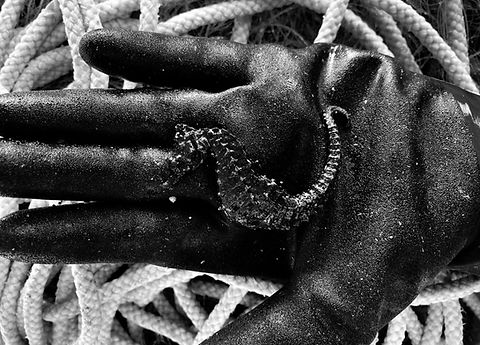

Short-snouted seahorse (Hippocampus hippocampus)
A crab

Mediterranean Red Sea Star (Echinaster sepositus)

Smooth Brittle Star (Ophioderma longicauda)

Hermit crab (Paguroidea)


Mediterranean feather star (Antedon mediterranea)
Colonial bryozoans
_edited_edited.jpg)
An eggcase of a skate (Raja sp.)

Hairy crab (Pillumnus sp.)

Different fragments of sponges

Brittle star (Ophiotrix sp.)

Mediterranean Shame-faced Crab (Calapa granulata)

Cave spider crab (Herbstia condyliata)